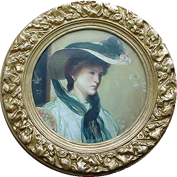
Antique Oil Painting attributed to William Widgery - "Mrs. Widgery"
Back to: Genre - Portraits - Caricatures

Title: Mrs. Widgery
Artist: attb. William Widgery
Date: c.1860-70
Description: Oil on board. Taken to be William's wife and Frederick's mother. A very finely painted oil on board with a textured background, it is inscribed verso:
"Our friend Mrs. Widgery of the Studio, Queen St. Exeter a true and faithful portrait of a talented painter, as well as musician, after these first pictures sent to Suffolk St. Galleries were sold in the 1st three days she and her father visited us Jan 1871. Received Saturday 13th 1872 at 6 Hillsborough Terrace, Ilfracombe. John Hesketh Lethbridge."
Underneath it is further inscribed in pencil William Widgery. Although unsigned it is known that William Widgery painted many genre and figurative subjects 'after' Edwin Landseer and it is distinctly possible that this portrait is by his hand.
Image size: 275 x 215mm, 10.75 x 8.5 ".
£1200.00
Order No. 258
William Widgery. (1826 - 1893)
Born in Uppercot, North Molton, Devon, he was a landscape, and animal painter who
began his working life as a stone mason plasterer. He later moved to Exeter
where he learned his craft by painting copies of engravings by Landseer.
He visited both Italy and Switzerland but is best known for his Devon and Dartmoor scenes.
From Art In Devonshire' by George Pycroft pub. 1881.-
'landscape painter in oil and watercolour, born at Uppercot, North Molton, 1822, worked in early life as a mason, and is a capital instance of the truth, that if there is genius in a man, it will come to the surface without any help, and in spite of the most adverse circumstances. He began painting in his leisure hours, and his friends thought much of his performances; but the man who had most influence in determining his future path in life was the late Thomas Hex, of St. Thomas, at whose inn the writer first saw Mr. Widgery's clever reproductions of some of Landseer's works,only known to the painter through the medium of engravings.
At Mr. Hex's advice Widgery gave up his trade, and trusted his all to his success as an artist. He painted and sold many copies of Landseer and Rosa Bonheur, made portraits of cattle and horses, and drew scenes from his neighbourhood in oil; and although his work at first was of course that of a beginner, the writer and the Dr. W. R. Scott, of the Deaf and Dumb Asylum, an excellent judge of art, used often to look at them when exposed for sale, and agree that the painter had a rare eye for, and was never wrong in his colour. Indeed, colour has ever been his strong point.
Widgery had no instruction from any man, or any books. There was no art gallery in Exeter to instruct his eye. He went boldly out into the fields, and sat himself down with the colour that he gradually learned to select, and he painted what he saw, with nature his only master. The consequence is that he has followed no man. It is impossible to say that "Widgery is of the school of so-and-so," although at the present time all the young painters are copying him. He has a style quite peculiar to himself, a style in which he catches effects,portrays rural scenes and wild landscapes boldly, and with very little finish.
At the present date he has practiced art for thirty years. He has painted over three thousand pictures, and has sold them all; indeed, they are generally sold before they are off his easel, and any left the dealers are ready to take immediately. He twice visited Italy and Switzerland, and for a time he painted glacier streams, and snowy mountains and views Venice; but he soon returned to the scenery of his native country. He has painted the coasts of Devon and Cornwall, and is particularly happy in his delineation of wild seas dashing on rugged iron-bound coast; but Dartmoor is the chief of his labours, and in after years he will be chiefly remembered as pre-eminently the painter of Dartmoor. He is a correct and spirited painter of animals, and introduces them with good effect. His pictures are well composed, and he has the power of selecting picturesque bits, and of arranging his subject in a bold easy manner, that appears utterly unstudied. He possesses the ars celare artem to perfection his touch is remarkably light and free; his colour is entirely without crudity of heaviness; he never uses any blue but cobalt, and every variety of green and grey he makes with this, the lightest of colours. He mixes a little of the pigment with all his tints, and thus carries a softening atmospheric effect over the whole of the work.'
Mon-Sat 10am-1.30pm, 2.30-5.30pm
Wed 10am-1.30pm
© Devonshire Fine Art
 Free UK Mainland Delivery*
9 Church Street
Modbury
Devon PL21 0QW. UK
01548 830872